Project Name: 400,000-ton Push-Pull Pickling Line
Customer Name: Dong'e County Yike Plate Industry Co., Ltd.
Project Nature: New Construction Project
Undertaking Method: EPC by Jingjieruis
Signing Time: April 7, 2011
Commissioning Status: Under Construction
Operation Status: Good
I. Description of the Pickling Line
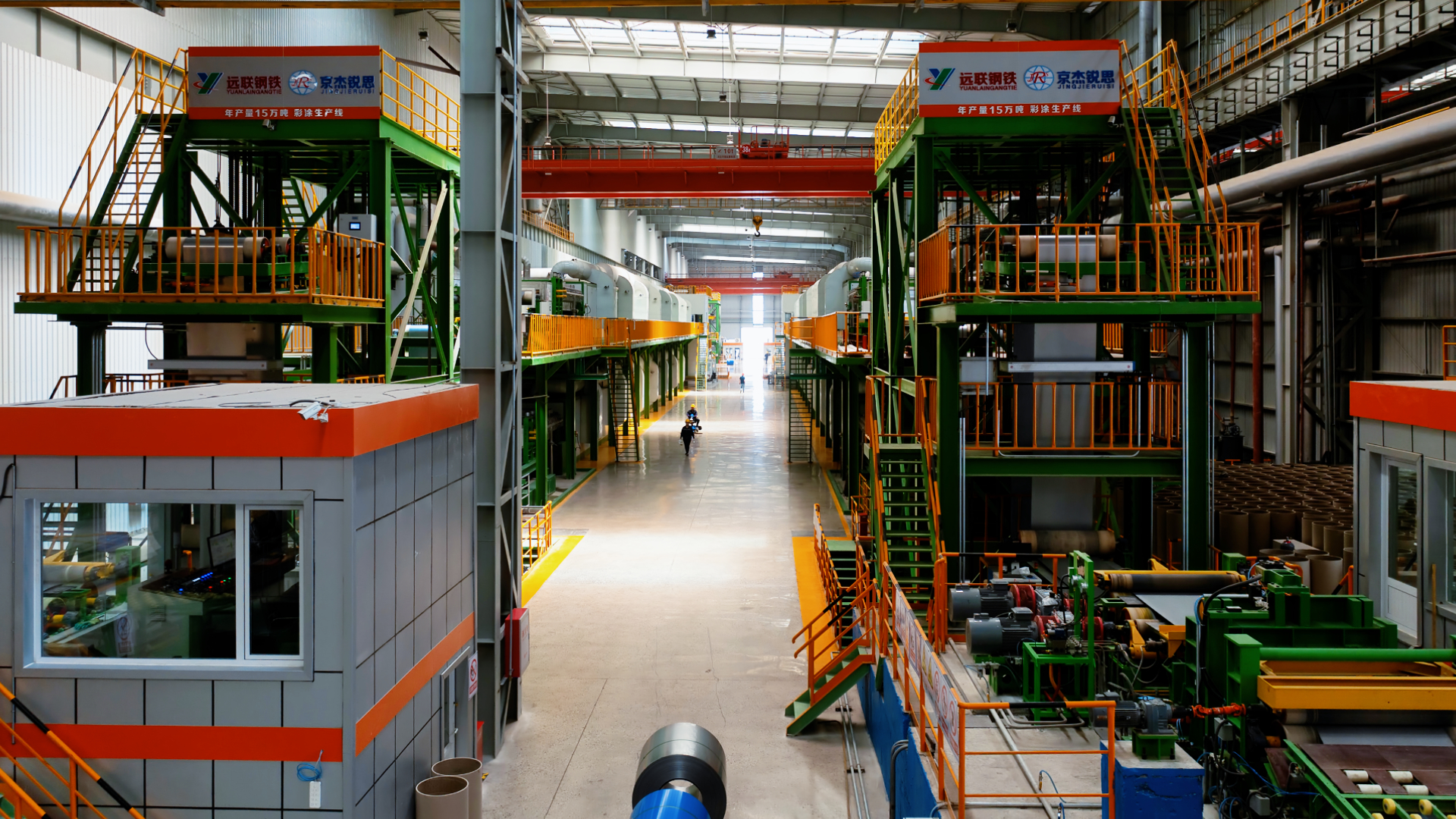
This pickling line is a push-pull pickling line, adopting the currently advanced shallow tank turbulent pickling technology. The provided process equipment and technology have been proven through production practice to be reliable, advanced, and mature, which can meet the complete set of equipment and technology required by the buyer for stable production and long-term operation. This technology features reasonable equipment structure, high operation efficiency, low production consumption, convenient operation, and few equipment operation failures.
The designed pickling line completes the entire process of steel strip pickling treatment from uncoiling to coiling online. An feeding trolley is installed at the entrance of the line. The steel coil is first placed on the receiving rack by a crane, and then the feeding trolley transports the steel coil to the center position of the uncoiler reel. The line adopts a cantilever uncoiler for uncoiling. The expansion and contraction of the uncoiler reel is driven by a hydraulic cylinder installed at one end of the reel mandrel. The uncoiler frame can move on the machine base driven by a hydraulic cylinder to adjust the center position of the steel coil during uncoiling. The tail shear is (driven by double hydraulic cylinders) to ensure sufficient shearing force. After the steel strip enters the pickling tank, the surface of the steel strip directly undergoes the following chemical reactions with the hydrochloric acid solution in the tank:
Fe₂O₃ + 6HCl === 2FeCl₃ + 3H₂O
Fe₃O₄ + 8HCl === 2FeCl₃ + FeCl₂ + 4H₂O
FeO + 2HCl === FeCl₂ + H₂O
Fe + 2HCl === FeCl₂ + H₂↑
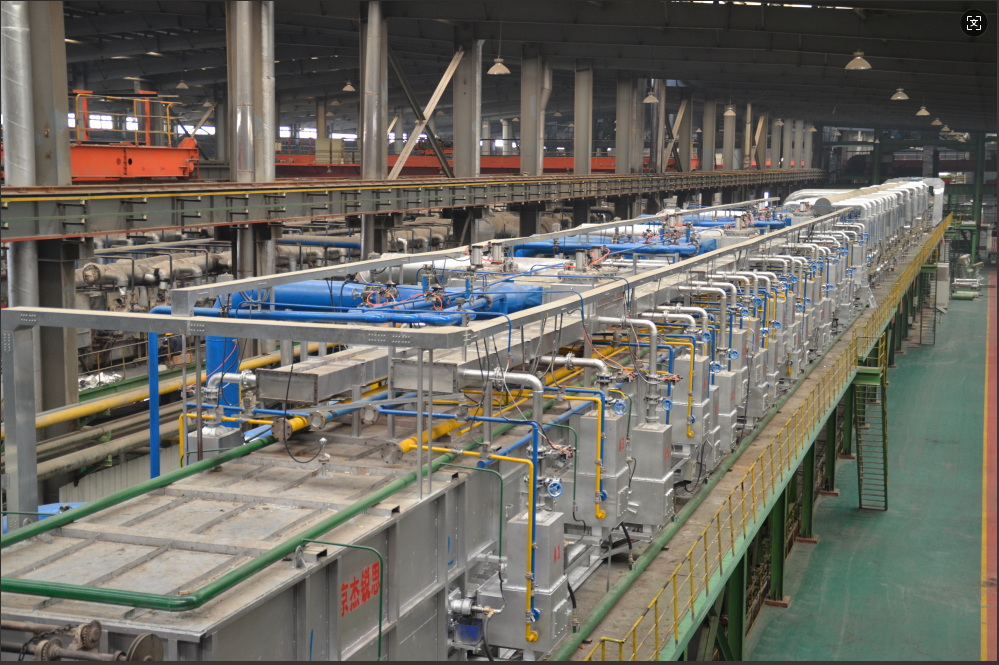
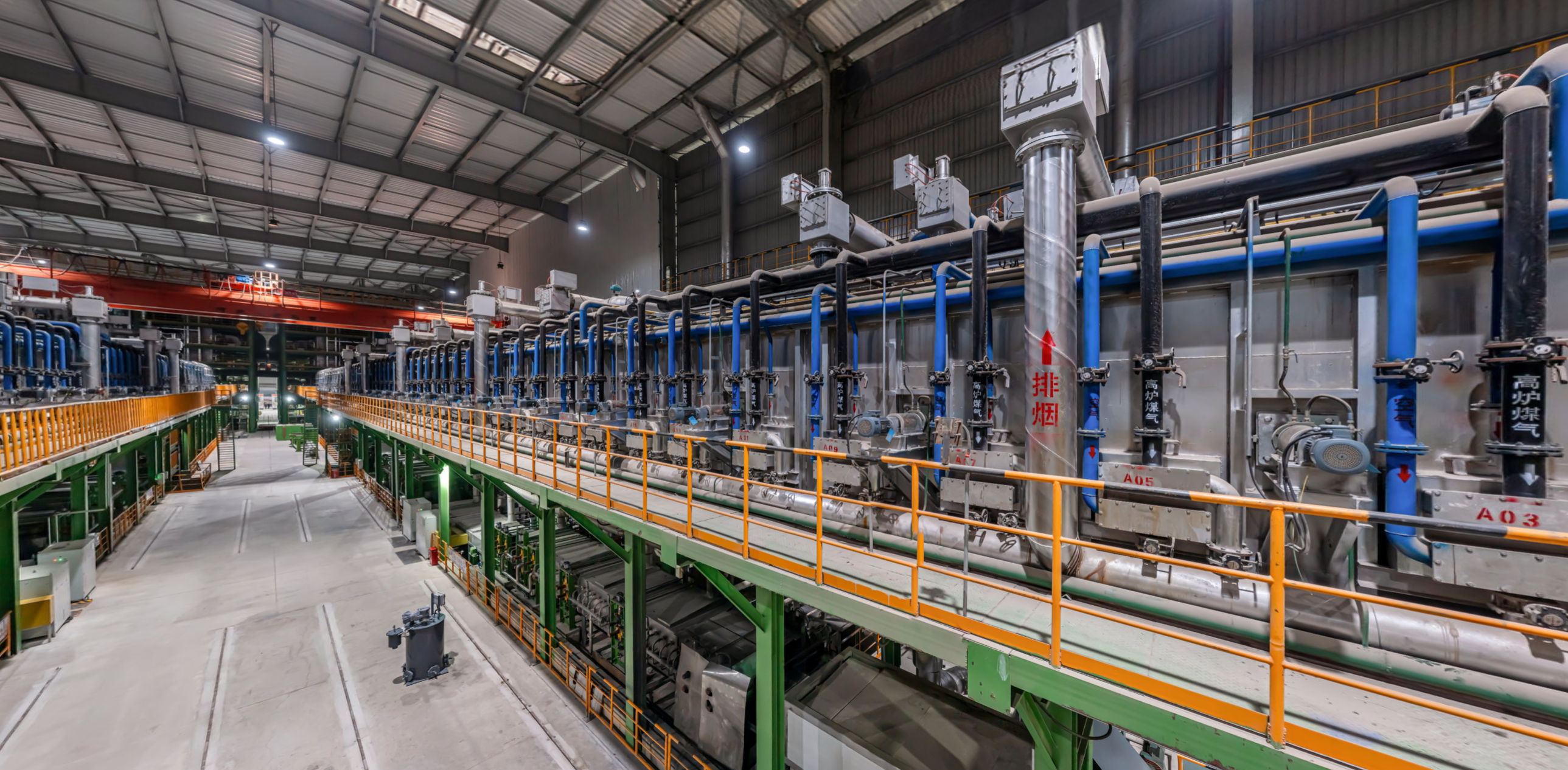
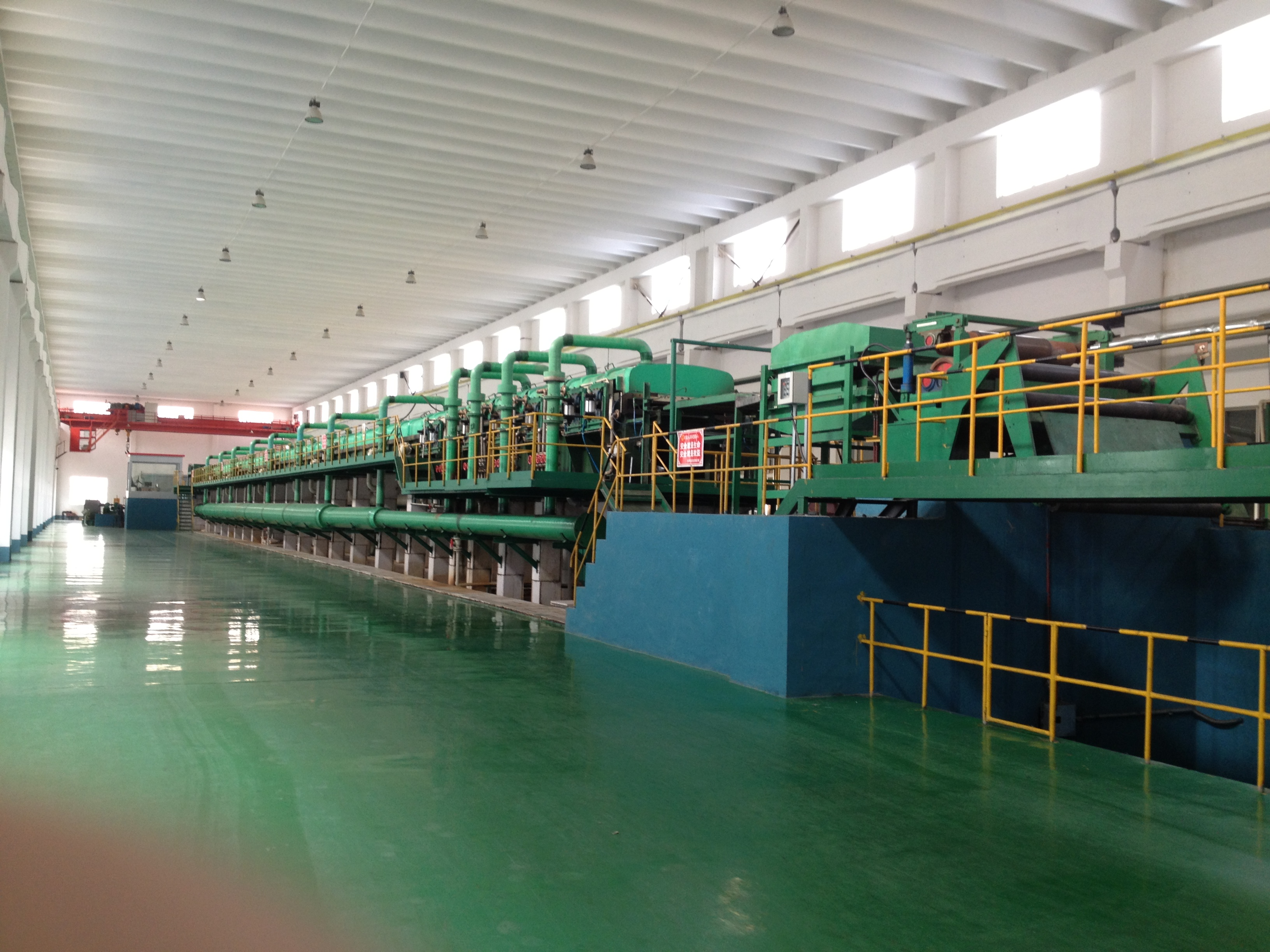
The pickling tank is divided into 4 sections. The tank body is of carbon steel structure, lined with neoprene and double-layer granite strips. This structure can avoid damaging the inner rubber layer when replacing the granite lining during maintenance. Acid squeezing rubber rolls and acid isolation chambers are installed between each section of the tank. The granite lined at the bottom of the tank is on the same plane as the lower roll surface of the squeezing rubber roll. A layer of granite cover is installed on the upper part of the steel strip running plane. The squeezing rolls are driven by frequency conversion, and the position of the strip head during threading can be detected through the change of motor current, so as to avoid overlapping and accumulation of thinner steel strips in the acid tank. Each section of the acid tank is equipped with a set of acid circulation heating system. The acid is heated by a vertical graphite heat exchanger. At the same time, under the action of the tank structure, the acid flows rapidly in a turbulent manner, thus greatly improving the pickling speed. New acid is continuously and quantitatively added from the 4# acid circulation tank, and at the same time, through the acid circulation tank liquid level control system, it is supplemented to 3#, 2#, and 1# step by step, and finally discharged from the 1# tank to the waste acid collection tank. Since each section of the pickling tank is relatively isolated and circulates independently, the concentration gradient of each section of the acid tank can be effectively controlled. The first section of the cleaning tank is cleaned independently. The remaining 3 sections are rinsed by cyclic spray (condensed water). Clean water is added from the 4th stage rinsing tank. The rinsing water flows from the 4th stage to the 2nd stage in the lower water collection tank of the cleaning tank, and finally is discharged from the overflow port of the 2nd stage to the rinsing water collection tank. The entire pickling tank and cleaning tank are controlled by micro-negative pressure. The acid mist is pumped to the acid mist washing tower of the waste acid regeneration station through the exhaust pipes installed at the inlet and outlet of each section, and discharged outside the factory after spray washing. The exhaust gas emission is about 16,000 m³/h, and the hydrogen chloride content is less than 50 mg/m³. The steel strip is dried by a hot air dryer, and the hot air is heated by a steam heat exchanger. The steel strip edge cutting adopts a cantilever disc shear. A pinch centering machine (CPC) is installed at the inlet of the disc shear to control the edge cutting centering. The cut waste edges are coiled into waste edge pellets by a waste edge coiler. The coiler adopts a cantilever tension coiler. The coiling tension is established by a three-roll driven tension machine. The coiling is equipped with EPC control to align the coiling edge. The outlet uncoiling is equipped with a hydraulically driven uncoiling trolley to transport the steel coil to the discharge rack.
The electrical control system of the line is composed of a power distribution system, AC frequency conversion motor drive device, AC motor control unit, PLC operation control system, main operating platform, sub-operating platform, and uncoiling industrial monitoring system. The operation control of the system is completed by a PLC programmable controller, and the operating system also includes the interlock control function of the auxiliary process system of the pickling line.
II. Design Ideas Followed by the Production Line
Need Satisfaction Principle: The designed products and performance meet the user's requirements to the greatest extent, which is carried out on the basis of investigating, analyzing, and predicting the market.
Economic Rationality Principle: The designed product has an advanced structure, good function, low cost, and convenient use and maintenance. The specified function of the product is realized with the lowest cost within the product life cycle.
Reliability Principle: The product has a high degree of reliability to complete the specified function under the specified use conditions and within the specified time.
Optimization Principle: Under the given design objectives, the most reasonable scheme is recommended to users by using optimization design methods.
Standardization Principle: The specifications and parameters of the designed product conform to national standards. The components are compatible with those of similar products to the greatest extent, and the components in the same product are interchangeable as much as possible.
Safety Principle: The designed product ensures the safety of operators and managers, the safety of mechanical equipment, and ensures that the equipment is harmless to the surrounding environment; the physical and mental consumption of workers during operation is reduced to the greatest extent.
Ergonomics Principle: Make the product coordinate with the human body in use, so that people can operate conveniently, have a comfortable environment, respond sensitively, and have high efficiency during machine operation.
III. Design Basis
Raw Materials: Cold-rolled carbon structural steel, high-quality carbon structural steel, and low-alloy steel coils
Steel Grades: Q195, Q235, ST12, ST13, SPCC, SPCD
Yield Strength: 210-360 N/mm²
Tensile Strength: 270-610 N/mm²
Specifications
Steel Strip Thickness: 1.8-4.0 mm
Steel Strip Width: 600-1300 mm
Inner Diameter of Raw Material: Φ510mm/Φ760mm
Inner Diameter of Product: Φ610mm
Outer Diameter of Steel Coil: max Φ2100mm; min Φ1100mm
Maximum Single Weight of Steel Coil Product: 26 t
Annual Operation Plan: 300 days * 24 hours
Energy Sources: Water, electricity, steam
Product Form: Coil-to-coil
Production Program: 400,000 tons/year
IV. Main Technical Indicators of the Production Line
Process Method: Push-pull shallow tank turbulent hydrochloric acid pickling
Layout of Production Line: Left to right from the operation side
Maximum Process Speed of Production Line: 120 m/min
Threading Speed: 10-60 m/min
Inching Speed: 10-30 m/min
Drive Mode of the Line: AC drive, frequency conversion speed regulation
Maximum Acid Concentration: 200 g/L HCl, 125 g/L Fe²⁺, 5 g/L Fe³⁺
Minimum Pickling Time: 26 s
Total Length of Acid Tank: Approximately 50 m
Total Length of the Line: Approximately 120 m
Maximum Uncoiling Tension: 20 KN
Maximum Coiling Tension: 65 KN
V. Requirements for Energy Media and Public Auxiliary Facilities
Electricity: Installed capacity of the line: approximately 1150 kw, excluding the power energy of workshop public facilities.
Among them:
Installed capacity of the main drive (AC frequency conversion motor) of the line: 600 kw
Installed capacity of auxiliary equipment (constant-speed AC motor) of the line: 550 kw
The power interface between the two parties is bounded by the upper port of the incoming line switch of the seller's control cabinet. The seller's switch is protected and provides relevant capacity. All cables and cable trays below the seller's control cabinet shall be provided by the buyer.
Compressed Air: 0.4-0.6 Mpa, 6 Nm³/min of purified air, 240 Nm³/min of non-purified air.
Water: The rinsing water is required to be softened water. The average consumption is approximately 5 m³/h.
Steam: It is required to provide a capacity of 6.5 t/h (P-0.5 Mpa 151℃ saturated steam), and the actual average consumption is approximately 5.5 t/h.
Exhaust Gas Emission: Approximately 16,000 m³/h
Pollution Control: Waste liquid: 4.5 m³/h of rinsing water
Waste Gas: HCl content less than 50 mg/m³
Effective Lifting Height of Crane: 9 m
VI. Process Flow
Crane loading to the receiving rack — feeding trolley — pre-uncoiling [floor roll — uncoiling knife — pinch roll — straightener (three-roll type) — head shear — corner shear (with scrap basket)] — uncoiler — movable telescopic guide plate — 5-roll leveler with pinch roll — tail shear (with scrap trolley) — vertical guide roll — manual welding platform — pinch roll — pickling tank — rinsing tank — edge blower — hot air dryer — pinch roll — rear looper (with swing arc roller table) — centering vertical roll — pinch centering machine — disc shear — waste edge coiler — three-roll tension roll — shearing machine — steering pinch roll — movable guide plate — coiler (with press roll) — movable support — unloading trolley — receiving rack — crane lifts the steel coil to the coil storage warehouse.