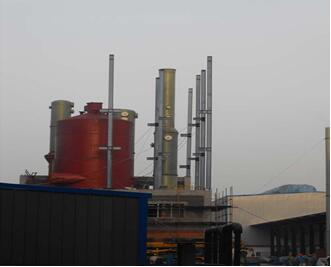
Project Name: Waste Acid Regeneration Unit
Customer Name: Hebei Baosheng Group
Project Nature: New Construction Project
Contracting Method: EPC by Jingjie Ruisi
Signing Time: November 12, 2010
Commissioning Status: Under construction
Operation Status: Good
I. Description of Production Process Flow
Waste acid from the pickling unit is collected in a waste acid tank, and then pumped through a waste acid filter into the pre-concentrator by a waste acid pump (the flow rate is automatically controlled by a pneumatic control valve). The waste acid is sent to the top of the pre-concentrator via the pre-concentrator circulation pump for spraying. It undergoes direct heat exchange with the furnace gas from the roasting furnace to evaporate part of the water in the waste acid, thus concentrating the waste acid. The concentrated waste acid is sent to the top of the roasting furnace through the waste acid filtration station by the roasting furnace feed pump, and then enters the roasting furnace for spraying through spray rods and nozzles. The roasting furnace is equipped with spray guns, each with a nozzle, and the spray guns can be automatically inserted into the roasting furnace.
The roasting furnace body is a steel shell lined with refractory and acid-resistant bricks. Burners are arranged tangentially on the body for heating, which dries the pre-concentrated acid droplets from the nozzles. In the hot zone of the roasting furnace, FeCL₂ and FeCL₃ decompose according to the following equations:
2FeCL₂ + 2H₂O + 1/2O₂ = Fe₂O₃ + 4HCL
2FeCL₃ + 3H₂O = Fe₂O₃ + 6HCL
Solid particles (Fe₂O₃) fall into the lower cone of the roasting furnace in powder form and are discharged through a rotary valve, which isolates the gas inside the roasting furnace from the external gas. An oxide lump crusher is installed above the rotary valve to crush the lumps falling from the roasting furnace wall.
The roasting furnace gas, composed of combustion exhaust gas, water vapor, and hydrogen chloride gas, leaves the top of the roasting furnace and passes through a cyclone separator to separate most of the Fe₂O₃ powder. The separated oxide is discharged through a rotary valve and returned to the roasting furnace. Then the roasting gas enters the pre-concentrator, where the high-temperature gas directly contacts the circulating acid to cool and clean the gas, leaving only a small amount of oxide, and then enters the absorption tower.
Rinsing water is used to absorb hydrogen chloride gas in the furnace gas. Rinsing water enters from the top of the absorption tower through nozzles, evenly distributing water on the packing in the absorption tower. In countercurrent flow, the hydrogen chloride in the gas is absorbed to form regenerated acid, which flows by gravity from the bottom of the absorption tower to the regenerated acid storage tank.
The furnace gas containing trace HCL leaves the top of the absorption tower, passes through a waste gas fan, and enters the scrubbing tower.
A droplet separator is installed after the waste gas fan to separate gas and liquid. The furnace gas containing trace HCL is circularly washed with rinsing water in the lower part of the scrubbing tower and with demineralized water in the upper part.
The waste gas fan controls the entire system to be under negative pressure to ensure no hydrogen chloride leakage.
The iron oxide powder produced by the roasting furnace is collected by a collection trolley.
Major industrial process parameters, i.e., temperature, pressure, and flow rate, are displayed digitally in the control room, while important operating parameters are automatically controlled by the PLC system. The start-up, control, and shutdown of equipment can be completed via the keyboard. Alarms and functional errors are recorded in an independent alarm memo, so operators can easily check the equipment operation status in the control room, and shift reports are provided by the printer.
The electrical drive and automatic instruments of the regeneration device are used to ensure the normal operation of the system and simplify operations. The PLC control system can ensure that any faults in the system are reflected in a timely manner, and can be connected to automatic alarms and automatic shutdowns. In the case of no faults, it can reflect the normal operation of the system. In case of equipment failure, the regeneration unit can automatically stop running.
The start-up and shutdown operations of this unit can be performed at any time. When starting the equipment, use the burner for heating, then operate with water until the correct flow rate, temperature, and pressure are reached, then switch the water supply to acid supply, and regeneration can start. For stopping the equipment operation, first cut off the acid supply, the equipment will automatically switch to water operation, and after a period of time, the regeneration unit will be completely shut down. The unit has three functions: fresh water operation, rinsing water operation, and acid operation (production).
II. Unit Capacity and Environmental Protection Indicators
1. Relevant Design Parameters of the Pickling Unit
Serial Number
Name
Description
Unit
1 Pickled strip quantity (inlet quantity) 60 10,000 t/year
2 Main varieties of pickled strip Low-carbon steel -
3 Annual working hours of pickling unit 7200 hours
4 Iron loss in pickling Approximately 0.45 %
2. Acid
a. New hydrochloric acid: colorless or light yellow transparent liquid
The grade indicators of new hydrochloric acid are as follows:
Index Name
Index Level
High-quality product First-class product Qualified product
Total acidity% (HCl) ≥ 31.0 31.0 31.0
Iron% ≤ 0.006 0.008 0.01
Sulfate% (SO₄²⁻) ≤ 0.005 0.03 -
Arsenic% ≤ 0.0001 0.0001 0.0001
Ignition residue% ≤ 0.08 0.10 0.15
Chloride% ≤ 0.005 0.008 0.010
b. Waste acid: from the pickling line
Serial Number
Name
Parameter
Unit
1 Total iron content 140 g/l
2 Total HCl
Among which: Free HCl
Fe 200
3-5
140 g/l
%
g/L
3 Temperature Approximately 85 ℃
4 Processing capacity of regeneration unit 4000 L/h
c. Regenerated acid
Serial Number
Name
Parameter
Unit
Remarks
1 HCl concentration 190-210 g/l -
2 Iron content ≤5 g/l Excluding Fe ions in rinsing water
3 Output 4000 L/h -
4 Cl⁻¹ recovery rate ≥99.5 % -
3. Iron Oxide Powder
Indicators of iron oxide powder:
Serial Number
Name
Parameter
Unit
1 Fe₂O₃ ≥99 %
2 FeO ≤0.4 %
3 H₂O ≤0.1 %
4 Cl⁻ ≤0.01 %
5 SiO₂ ≤0.02 %
6 Primary particle size ≤1.0 μm
4. Capacity and Heat Consumption
4.1 Capacity Calculation of Acid Regeneration Unit
a. Unit processing capacity
Waste acid processing capacity: 4 cubic meters per hour.
Waste acid concentration: ~200g/L HCl
Waste acid temperature: ≤85℃
Fe content in waste acid: ~120 g/L waste acid
5. Environmental Protection Indicators
a. Noise: Noise shall not exceed 80 Db (measured 1m away from the equipment). Equipment exceeding 80 Db shall be installed in an isolation room for isolation.
b. Waste gas emission
The flue gas discharged from the outlet of the scrubbing tower contains:
HCl ≤20mg/Nm³
Fe₂O₃ ≤30mg/Nm³
Cl₂ ≤5mg/Nm³
The exhaust gas discharged from the top of the iron oxide powder silo has Fe₂O₃ content <10mg/Nm³ and particle size ≤20μ.
The above indicators are guaranteed to meet China's environmental protection emission standards.
c. Waste liquid discharge
There is no waste water discharge during the normal operation of the unit. Waste liquid is discharged only during start-up, shutdown, or when cleaning spray guns and equipment, and it is intermittent discharge.
Acid-containing wastewater discharge (intermittent): 3.5m³/h, temperature: 40℃, specific gravity: 1.01kg/dm³,
containing Fe 5g/L, HCl 0~200%
d. Workshop air
HCl content ≤5mg/Nm³
Fe₂O₃ content ≤10mg/Nm³