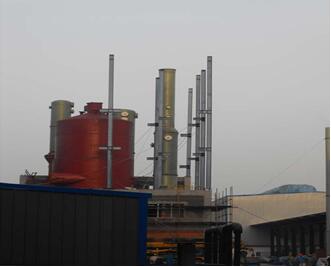
Project Name: Waste Acid Regeneration Unit
Customer name: Zhejiang Yuanli Group
Project nature: new construction
Undertaking method: Jingjie Ruisi general contracting
Signing time: September 18, 2009
Production status: On time production
Operation: Good condition
Waste acid regeneration principle and process:
Hot-rolled steel plates can be cold-rolled after being pickled with hydrochloric acid. During hydrochloric acid pickling, the iron and iron oxide skin on the surface of the steel plate are washed away by hydrochloric acid, and the consumed hydrochloric acid is converted into chloride dominated by FeCL2, which is dissolved in the hydrochloric acid solution. In order to maintain the concentration of free HCL in the pickling acid, remove the increased iron ions in the acid solution, send the waste acid liquid to the acid regeneration device to generate free acid, and then return to the pickling unit to reuse the waste acid regeneration process and obtain iron oxide powder at the same time.
The pickling process is as follows:
Fe 2HCL=FeCL2 H2
FeO 2HCL=FeCL2 H2O
Fe2O3 2HCL = FeCL2 FeCL3 H2O
Fe2O3 6HCL=2FeCL3 3H2O
2FeCL3 Fe=3FeCL2
4FeCL2 4HCL O2=4FeCL3 2H2O
The waste acid from the pickling unit is collected in the waste acid tank and fed to the concentrator through the waste acid filter by the waste acid pump (the flow rate is automatically controlled by a pneumatic control valve). Waste acid is pumped to the top of the concentrator by circulating through the concentrator for spraying. Direct heat exchange with furnace gas (400°C) from the roasting furnace evaporates part of the water in the waste acid and concentrates the waste acid. The concentrated waste acid is sent to the top of the roaster by the roasting furnace feed pump through the waste acid filtration station, and then enters the roasting oven for spraying through the boom and nozzle. The roasting oven is equipped with a spray gun, each of which is equipped with multiple nozzles, and the spray gun can be automatically inserted into the roasting oven.
The main body of the roasting furnace is a steel shell, which is lined with refractory and acid-resistant bricks, and 2 burners are arranged tangentially on the main body to heat, and the concentrated acid droplets from the nozzle are dried, and in the hot area of the roasting furnace (500-800°C), FeCL2 and FeCL3 are decomposed according to the following equation:
2FeCL2 2H2O 1/2O2=Fe2O3 4HCL
2FeCL3 3H2O=Fe2O3 6HCL
Solid particles (Fe2O3) fall in the form of powder in the lower cone of the roasting oven and are discharged by a rotary valve that isolates the gas inside the roasting oven from the outside gas. An oxide block crusher is installed in the upper part of the rotary valve. Used to break up clumps falling from the walls of the roasting furnace.
The roasting furnace gas is composed of combustion exhaust gas, water vapor and hydrogen chloride gas, which leaves the roasting furnace from the top of the roasting furnace and separates most of the Fe2O3 powder contained in it through a cyclone. The separated oxides are discharged through a rotary valve and returned to the roasting oven. The roasting gas then enters the preconcentrator, where the high-temperature gas is directly in contact with the circulating acid to cool and clean the gasOnly a small amount of oxide remains and enters the absorption tower. Absorb hydrogen chloride gas from furnace gas with rinse water. The rinse water enters through the nozzle from the top of the absorption tower and distributes the water evenly over the packing material in the absorption tower. In the reverse flow, the hydrogen chloride component in the gas is absorbed to form regenerative acid, which flows from the bottom of the absorption tower to the regenerated acid storage tank. The furnace gas containing trace amounts of HCL leaves the top of the absorption tower and enters the scrubber through the exhaust gas fan (cleaning the fan impeller with industrial water, which plays the role of cleaning device and cooling and cooling). The exhaust fan is followed by a droplet separator, where gas and liquid are separated. Furnace gas containing trace amounts of HCL is circulated with rinse water in the lower part of the scrubber and with demineralized water in the upper part of the scrubber. The exhaust fan controls the whole system in a negative pressure state to ensure that no hydrogen chloride will leak out of the system. The iron oxide powder produced by the roasting furnace is transported to the iron powder silo by a pneumatic conveying system, and a plastic plate dust collector is installed in the upper part of the silo to clean the air used during the transport of Fe2O3, and then discharge the air into the atmosphere. At the bottom of the silo, the Fe2O3 powder is discharged into the bagging machine through a portal valve. The main industrial process parameters, namely temperature, pressure and flow, are displayed digitally in the control room, while the important operating parameters are automatically controlled by the PLC system, and the starting, control and stop of the equipment can be completed by the keypad. Alarms and functional errors are recorded in a separate alarm memo, so it is easy for the operator to check the operating status of the equipment from the control room and the shift report is provided by the printer. The electrical transmission and automation instrumentation of the regeneration unit are used to ensure the normal operation of the system and simplify operation. The PLC control system can ensure that any fault of the system can be reflected in time, and can be connected to automatic alarm and automatic shutdown. In the absence of faults, the normal operation of the system can be reflected. In the event of equipment failure, the regeneration unit can automatically stop operating. The start and stop operation of this unit can be carried out at any time, when starting the equipment, heat it with a burner, and then operate with water until it reaches the correct flow, temperature and pressure, and then switch the water supply to acid supply, and the regeneration can begin. The unit has three functions: new water operation (for cleaning the roaster), flush water operation (roasting furnace heat load, cleaning pipes), and acid operation (production).